Compare battery energy without inventing runtime
Nominal volts multiplied by amp-hours gives nominal watt-hours. That arithmetic does not establish usable energy, power output, compatibility or minutes of work.
Updated:

Calculate the labelled quantity and name its limit
Multiply the stated nominal voltage by the rated amp-hour capacity to obtain nominal watt-hours. Keep both original labels with the result. Do not replace a nominal figure with a marketing maximum unless the comparison explicitly requires that different quantity and its conditions.
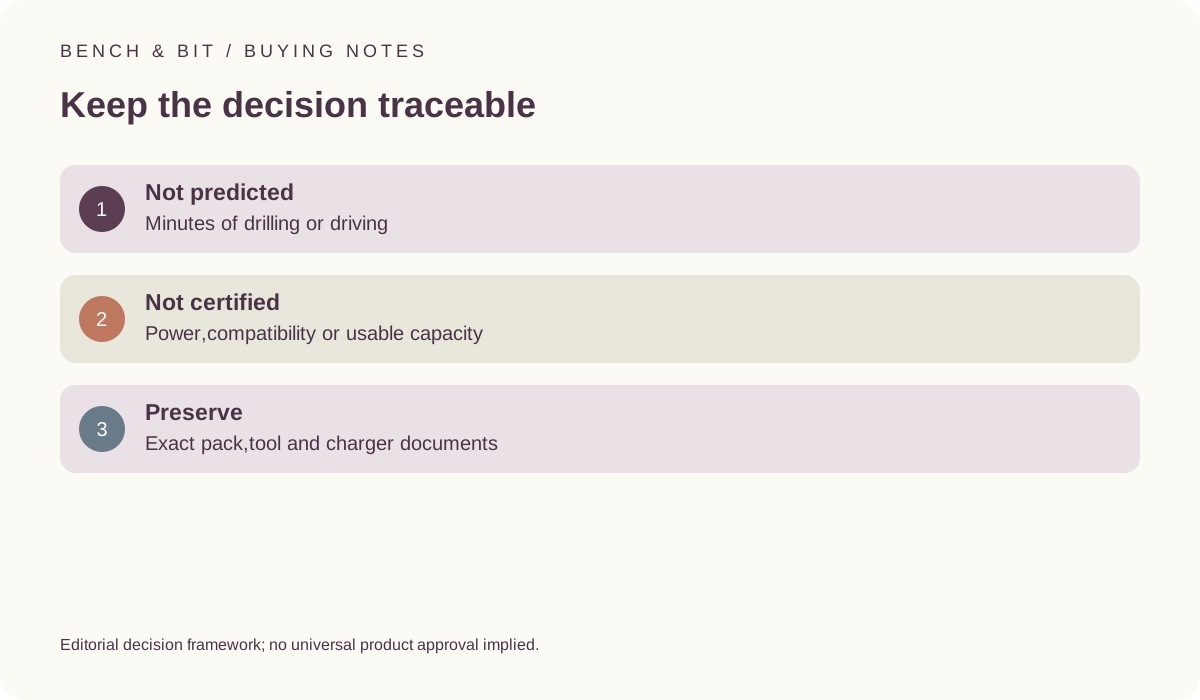
The result is a label-based energy calculation, not a runtime prediction. It does not establish how much energy is usable in a particular tool or battery condition, how much power a pack can deliver, or whether the pack is approved for the tool and charger. The tool on this site states those limits alongside its inputs.

Compare an explicitly hypothetical set of inputs
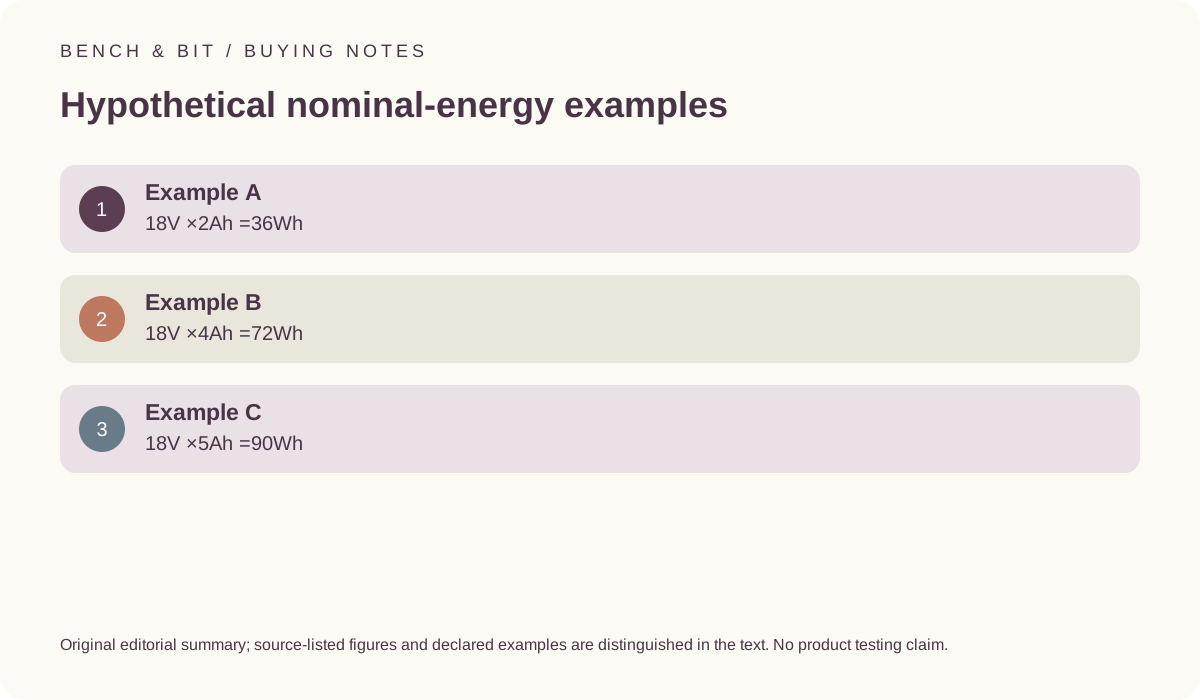
For invented nominal labels,18V multiplied by 2Ah gives 36Wh,18V multiplied by 4Ah gives 72Wh, and 18V multiplied by 5Ah gives 90Wh. These examples are arithmetic, not specifications or measured results for the photographed packs. The entered capacity must be the value for the actual pack being compared.
A larger calculated energy figure is not automatically the better purchase. Weight, dimensions, manufacturer recommendations, required tasks and the complete cost remain separate conditions. Do not turn the ratio between two hypothetical energies into the same ratio of holes drilled or fasteners driven.
Do not infer charging time from energy alone
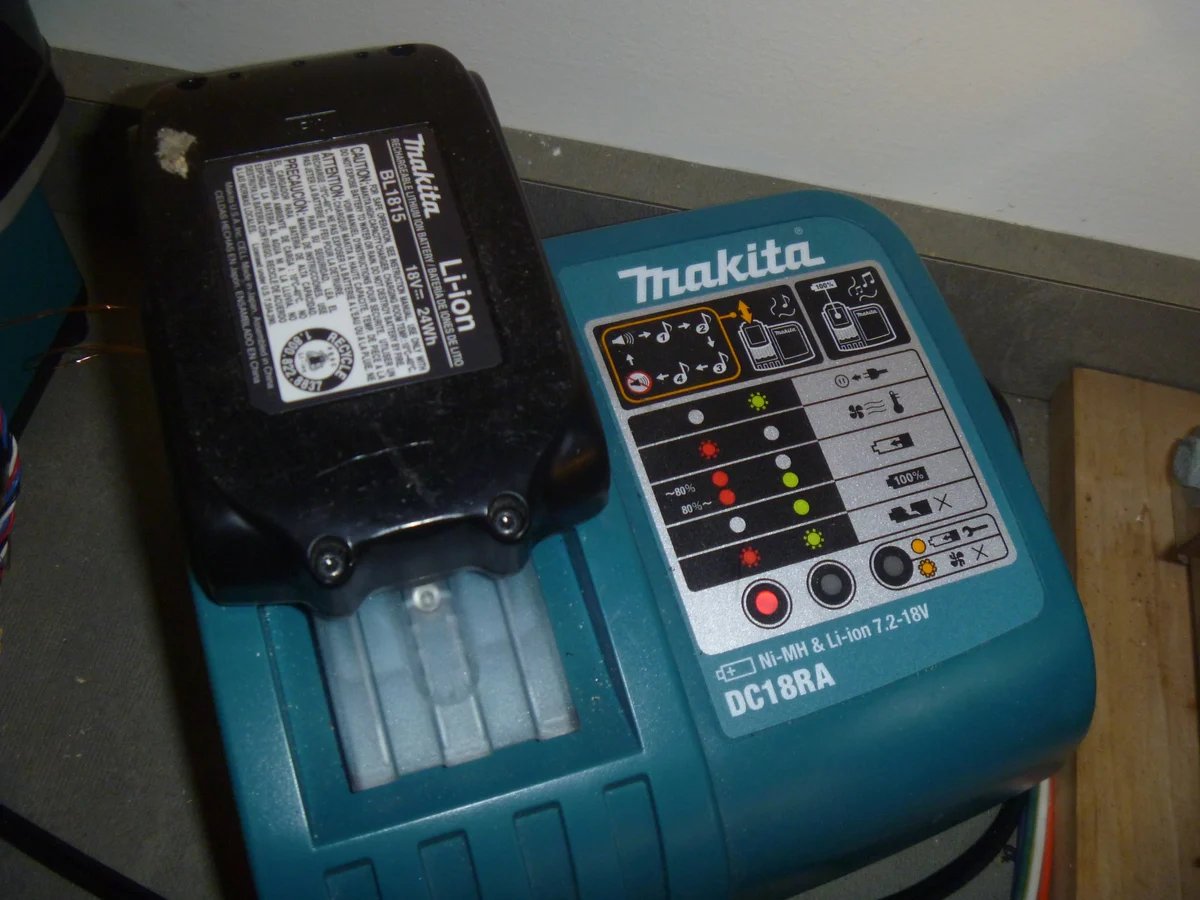
Charging time belongs to a particular battery and charger combination under stated conditions. The nominal-energy calculation does not include a charger’s behaviour, temperature conditions, battery state or charging controls. A charger photograph or a faster-sounding product name cannot supply the missing evidence.
Look up the exact combination and retain the manufacturer’s time statement with its qualifications if charging time matters to the purchase. Our real photographs identify contacts, a charging arrangement and separate packs; they are not an experiment or an instruction for charging damaged or uncertain equipment.
POWER FOR ALL official battery FAQ ?
Keep compatibility outside the arithmetic
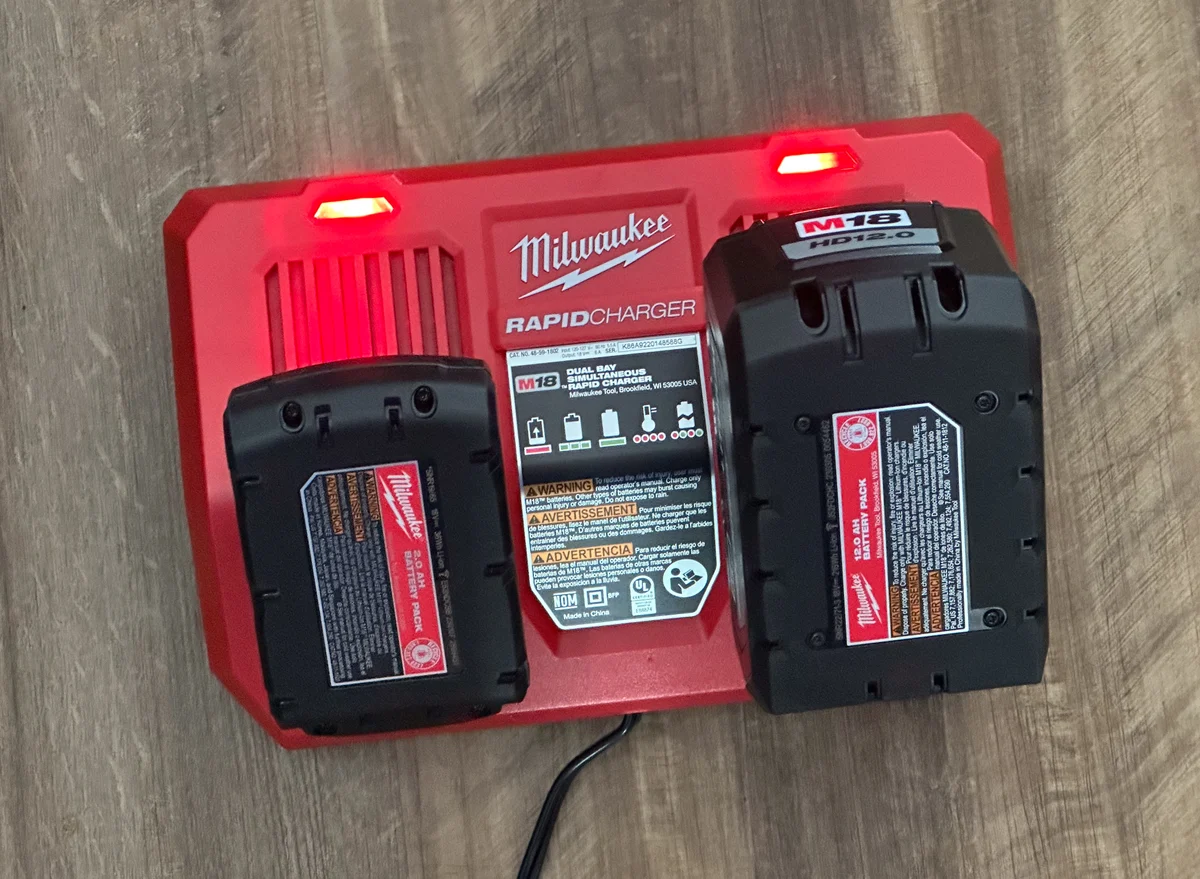
Two packs with the same nominal energy can have different interfaces, electrical systems and intended applications. Multiplication cannot resolve those differences. The correct tool, pack and charger identifiers still need the manufacturer’s documented compatibility information.
Use the calculation as one column in a larger purchase record rather than a universal replacement test. Do not assume a common brand, similar housing or matching voltage is a complete approval. A nominal-energy figure also gives no permission to modify a pack, combine cells, use an unofficial adapter or repair a charging system.
POWER FOR ALL official battery FAQ ?
Use the calculator as a traceable worksheet
Enter the nominal voltage and rated capacity from your chosen source, keeping that source with the result. Blank, non-finite and non-positive values are rejected. Editing either field clears the prior output, while resetting returns the clearly labelled hypothetical example. These controls help keep the arithmetic attached to the current inputs.
The next action is a documented comparison with limits visible: label energy, exact compatibility, relevant manufacturer recommendation and complete purchase allowance. We have not tested battery endurance or current delivery, and do not claim a particular number of minutes, holes or charge cycles for the packs shown here.